Unlock Your Potential.
Advance Your Career.
Practical, skills-based training for working professionals ready to grow — in the boardroom and beyond.

Cybersecurity Awareness
Understand today's cyber threats and build the habits to protect yourself and your organisation online.
AI Applications in Workplace
Learn to use generative AI tools like ChatGPT, Gemini, and Copilot safely and effectively at work.
Agentic AI Systems for Enterprise Workflow Automation
Build practical skills in agentic AI systems and workflow automation to drive digital transformation.
Innovate with GenAI for Business Impact
Apply generative AI to workplace content creation, storytelling, and stakeholder engagement.
Invest in the Skills That Matter Most
All courses are designed for working professionals and delivered by expert facilitators.

Cybersecurity Awareness
Understand today's cyber threats and build the habits to protect yourself and your organisation online.

Agentic AI Systems for Enterprise Workflow Automation
Build practical skills in agentic AI systems, workflow automation, and prompt engineering to drive operational efficiency and digital transformation.

AI Applications in Workplace
Learn to use generative AI tools like ChatGPT, Gemini, and Copilot safely and effectively to boost everyday productivity.

Innovate with GenAI for Business Impact
Apply generative AI to content creation, storytelling, and stakeholder engagement — while learning to evaluate and use GenAI tools responsibly.

Excellence, Integrity, Continuous Improvement
Our dedication to excellence, integrity, and continuous improvement ensures that every course we offer not only meets but exceeds the expectations of our learners and partners.
We offer a wide range of courses tailored to meet the needs of today's dynamic job market. Our curriculum takes a holistic approach, integrating technical proficiency with essential soft skills — each course meticulously designed and taught by industry experts.
Empowering personal and professional growth through high-quality, accessible education in an inspiring and motivating learning environment.
Our Core Values
Excellence
We pride ourselves on delivering training that is both rigorous and relevant, equipping learners for a dynamic job market.
Innovation
We constantly evolve our teaching methods, materials, and technology to stay ahead in a rapidly changing world.
Integrity
Transparency and ethical practice are cornerstones of our operations, fostering trust with learners, staff, and partners.
Collaboration
We work closely with industry experts, academic institutions, and employers to keep our courses practical and impactful.
A Community, Not Just a Training Centre
Edubright is not just a training centre — it's a community where learning and real-world application converge. We offer a unique blend of academic rigor, practical skills training, and personal development, focusing not just on what you learn, but how you learn and apply it.
With a network of experienced professionals, we provide an unparalleled learning experience. Our commitment extends beyond the classroom — we're actively involved in community initiatives, ensuring the benefits of education reach every corner of society.

Join Our Community
We're more than just educators — we're catalysts for change, champions of learning, and partners in your journey to success. Join us and be part of a community that's shaping the future, one learner at a time.
Associate Trainer
We are looking for individuals who are ACTA / ACLP Certified and keen to conduct training programmes and lessons at our training centre.
Insights for the Modern Professional
Practical articles, guides, and tips on professional development — written by our trainers and industry experts.





Subscribe to Our
Newsletter

We'd Love to Hear From You
Whether you're an individual ready to upskill or an organisation looking for a training partner — our team is here to help you find the right solution.
Contact Information
Reach us by phone, email, or visit us at our office.
#07-34, A'Posh Bizhub
Singapore 768160
Sat & Sun: 9:00 am – 6:00 pm
Public Holidays: Closed
Send Us a Message
Fill in the form below and we'll respond within one business day.
Personal Data Protection Policy
Your personal data is important to us and we are committed to complying with the Personal Data Protection Act 2012 (the "PDPA"). This personal data protection policy ("Policy") sets out how we collect, use and disclose your personal data and applies to Edubright Consultants Pte. Ltd. This Policy supplements but does not supersede nor replace any other consents you may have previously provided to us in respect of your personal data.
1. Personal Data
The PDPA defines personal data as data, whether true or not, about an individual who can be identified from that data, or from that data and other information the organisation has or is likely to have access to. This may include (but is not limited to) name, NRIC number, passport number, employment pass number, nationality, gender, photograph, video footage, phone numbers, mailing address, email address, age, date of birth, marital status, signature, job title, medical or financial information, and any other information you provide us through our forms or other interactions.
2. Collection of Personal Data
We may collect your personal data directly or indirectly, including when you contact us with queries or feedback, complete our enrolment, survey or feedback forms, participate in our marketing events, register for or use our services, submit an employment application, provide contact details, are captured on CCTV at our premises, visit or browse our website, subscribe to email alerts, or interact with our staff by phone, email, or in person.
We may also collect personal data about you from third parties, such as your representatives, employers, or our business partners. If you provide us with personal data about a third party, you confirm you have their consent to do so.
3. Use and Disclosure of Your Personal Data
We use your personal data to administer marketing activities; provide and send you information about our programmes and services; facilitate customer service and respond to enquiries or complaints; manage our administrative and business operations; conduct market research; provide training to our staff; manage the safety and security of our premises; comply with applicable laws and regulations; verify your identity; process employment applications; and for any other purpose we have notified you of or that a reasonable person would consider appropriate.
We may share your personal data with our agents, contractors and service providers, our professional advisers, business partners and affiliates, and courts, tribunals or regulatory authorities as required by law.
4. Security and Storage of Personal Data
We take reasonable efforts to protect your personal data through security arrangements such as staff training on confidentiality, restricting data access to employees who need it, and storing data in secure computer and physical storage facilities. We cannot, however, guarantee the security of information transmitted over the internet and encourage you to take precautions when using our online services.
5. Retention of Personal Data
We cease to retain your personal data once we no longer need it for the purposes it was collected for, or for any business or legal need.
6. Accuracy, Access and Correction
We take reasonable efforts to keep your personal data accurate and complete, but rely on you to inform us of any changes. You may write in to find out how we use or disclose your personal data, and to request correction of any error or omission; we will aim to respond within 30 days, and may need to verify your identity beforehand.
7. Transfer of Personal Data
If we need to transfer your personal data overseas, we will ensure the recipient country offers a comparable standard of protection, or enter into a contractual agreement to accord similar protection to that under Singapore's PDPA.
8. Do-Not-Call and Cookies
Before making telemarketing calls, we check the Do-Not-Call Registry and our internal blacklist, unless you have given clear consent.
Our website may use cookies to recognise return visitors and understand how you use our site. You may disable cookies in your browser settings, though this may affect some site functions.
9. Third-Party Sites
Our website may link to third-party websites, such as our business partners. We are not responsible for their privacy practices and encourage you to review their own policies.
10. Contacting Us
If you have questions or feedback about this Policy, would like to withdraw consent, or wish to exercise your rights under the PDPA, please contact us at:
1 Yishun Industrial Street 1, #07-34, A'Posh Bizhub, Singapore 768160
For PDPA queries, contact our DPO at training@edubright.sg
Terms and Conditions
1. Collection of Information
- Individual participants using SkillsFuture Credit as the payment mode must provide their full name, date of birth, full NRIC number, and available SkillsFuture Credit balance. Mid-Career Credit is not applicable to any of our courses.
- Corporate participants applying for AP / Training Grant funding must provide full name, date of birth, NRIC, and company details.
- Please ensure the correct UEN of the sponsoring company contributing the trainee's CPF is provided.
- Trainees must have Singpass Mobile App access to enrol in and attend SkillsFuture Singapore (SSG)-funded courses.
- Edubright will not sell or share collected information with any other party, except for funding and training administration purposes.
- By registering for our training courses, you consent to Edubright Consultants Pte Ltd using your personal data — including photos and videos — for: (a) training matters such as course details, administration, and course-related surveys; and (b) marketing and promotional information about Edubright's products and services. See our Privacy Policy for more information.
2. Payment Terms
- All Course fees are Non-GST.
- Edubright will issue an invoice upon course registration.
- Full payment, or your SkillsFuture claim, must be submitted once the course is confirmed.
- Cheque payments should be made payable to "Edubright Consultants Pte Ltd".
3. Course Confirmation
You will receive a confirmation email with full training details, including venue and time, once full payment has been made.
4. Replacement, Rescheduling, Change of Course, or Withdrawal
- Replacement: You may replace a registered participant by submitting written notice at least 3 working days before the course, at no additional charge.
- Rescheduling: You may reschedule your class once at no charge, within 1 month of the original start date, with written notice at least 3 working days in advance. Subsequent reschedules incur a $50 fee. For medical reasons, an MC must be submitted within 2 working days.
- Change of course: You may switch to another course by submitting written notice at least 3 working days before the original course date. The new course must be of equal or lesser value; if it is more expensive, you are responsible for the balance.
- Withdrawal: Withdrawing less than 5 working days before the start date incurs a $50 cancellation fee. Not attending, without a valid reason provided within 5 working days, will incur the full course fee.
- No-show: Any late rescheduling, change, or withdrawal is treated as a no-show and incurs a $50 fee.
5. Class Cancellation by Edubright
Edubright reserves the right to change the venue, or cancel or postpone a class, with prior notice. A full refund will be given under such circumstances.
6. Other Terms
- All classes are conducted in English, unless otherwise stated; trainees should have at least basic english to participate.
- Our classrooms are not wheelchair-accessible. Trainees with special needs should inform us in advance.
- Edubright reserves the right to decline trainees or customers who are not respectful to our staff or trainers.
- SkillsFuture Singapore (SSG) grants are only available to trainees who attend at least 75% of sessions and pass the course's assessment, where applicable.
7. Declaration
By submitting your registration online, you declare that:
- The information you have provided is accurate and true.
- You understand and agree to these Terms and Conditions.
- You agree to receive communications from Edubright related to our training courses.
Why Cybersecurity Awareness Is Every Employee's Responsibility
5 Ways AI Is Changing the Way We Work — And How to Keep Up
Design Thinking: A Framework for Solving Problems That Actually Matter
Your Complete Guide to Using SkillsFuture Credits in 2026
Why Emotional Intelligence Is the Most Important Leadership Skill You're Not Developing
7 Time Management Habits of Highly Productive Professionals
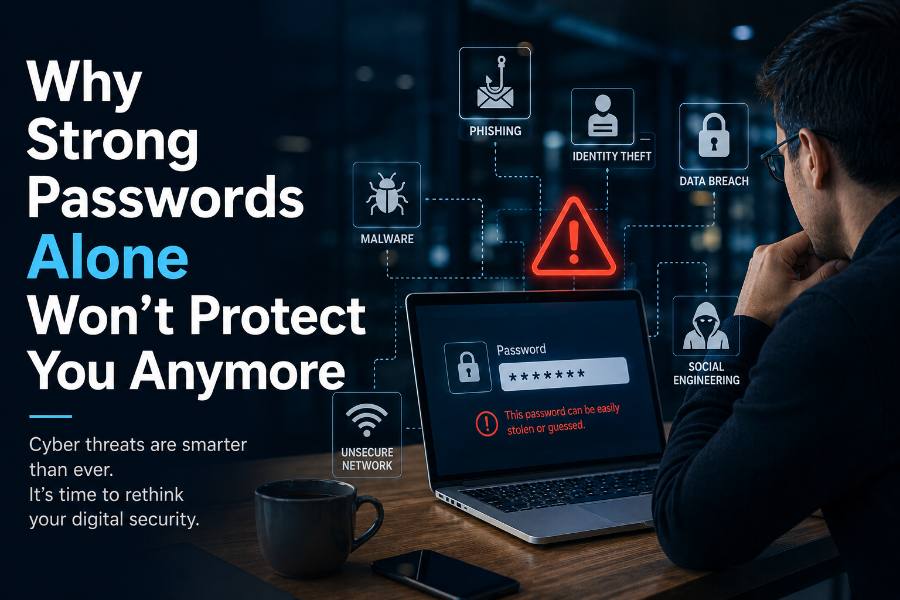
Why Strong Passwords Alone Won't Protect You Anymore
Most breaches don't start with a genius hacker cracking a firewall — they start with an employee clicking a link, opening an attachment, or reusing a password. Cybersecurity has quietly become everyone's job, not just IT's.
Where the real risk lives
Phishing emails are the most common entry point, often impersonating a colleague, vendor, or bank to create urgency. Social engineering goes further, manipulating trust rather than technology — a phone call from "IT support," a QR code on a flyer, a USB drive left in a lobby.
Habits that actually help
A few habits do most of the work: pause before clicking links in unexpected emails and check the sender's actual address; use a unique password for every account, ideally via a password manager; turn on two-factor authentication everywhere it's offered; and report anything suspicious instead of quietly deleting it.
None of this requires a technical background — just the awareness that a thirty-second pause can prevent the kind of incident that takes months to clean up.
Generative AI has moved from novelty to daily tool in a couple of years. Here's where it's actually changing how work gets done — and what that means for the people doing it.
1. Repetitive admin is disappearing
Scheduling, first-draft emails, meeting summaries, and data entry are increasingly automated, freeing up hours for higher-value work.
2. Research happens in minutes, not days
AI tools can synthesise large amounts of information quickly, though the output still needs a human to verify accuracy and judgement.
3. Decisions are more data-informed
Teams are using AI to model scenarios and surface patterns that would take much longer to find manually.
4. Communication is more personalised
From customer messaging to internal updates, AI helps tailor tone and content to the audience at scale.
5. Roles are shifting toward judgement
As AI absorbs routine tasks, the value of a role increasingly sits in oversight, creativity, and knowing which questions to ask.
Keeping up doesn't mean becoming a data scientist — it means building basic AI literacy, learning to write a clear prompt, and treating these tools as a collaborator to direct, not a black box to trust blindly.
Design thinking is often filed under "for designers," but it's really a problem-solving method — one built around understanding the person a problem affects before jumping to a solution.
The five stages
Empathise — talk to the people experiencing the problem instead of guessing. Define — state the real problem clearly, not the symptom. Ideate — generate many possible solutions before judging any of them. Prototype — build the cheapest possible version to test an idea. Test — get real feedback and iterate.
Why it works outside design
A slow internal process, a confusing customer form, or a clunky handover between teams are all design problems. The framework forces you to test cheap assumptions — a paper mockup, a rough script, a one-week pilot — before committing real budget and time.
The habit worth borrowing, regardless of your role: define the problem from the user's point of view before you start solving it.
SkillsFuture Credit can offset a meaningful chunk of course fees, but most Singaporeans don't use the full amount they're entitled to. Here's what's actually available in 2026 and how to claim it.
What you have
Every Singapore Citizen aged 25 and above holds a base $500 SkillsFuture Credit that never expires. Citizens 40 and above also hold a $4,000 Mid-Career credit, also permanent. A separate one-off $500 top-up issued in 2020 expired on 31 December 2025 — if it wasn't used by then, it's gone, so it's worth checking your credit history on MySkillsFuture to see what remains.
Stacking it with subsidies
Credit is applied on top of course fee subsidies, not instead of them. Singaporeans aged 40 and above can also access the SkillsFuture Mid-Career Enhanced Subsidy, which covers up to 90% of course fees for eligible programmes — credit then covers most or all of what's left.
How to claim
Register for your course with the training provider first — you'll need the course details on hand. Then log into MySkillsFuture with Singpass and submit your claim before the course start date. Approved WSQ courses, like the ones we run, are already listed on the portal as SkillsFuture Credit eligible.
2026 has also brought a bigger government push toward AI-related upskilling, with clearer AI learning pathways and course recommendations rolling out on the portal — a good moment to put unused credit toward a future-relevant skill.
Technical skill gets you into the role. What determines whether you're trusted to lead a team is usually something less visible on a resume: emotional intelligence.
The four components
Self-awareness — noticing your own reactions as they happen. Self-management — choosing your response instead of being run by it. Social awareness — reading the room and picking up on what isn't being said. Relationship management — turning that awareness into trust and influence.
Building it in practice
Three habits do most of the work: pause before reacting to frustrating news; name the emotion in the room instead of ignoring it ("this feels like a tense conversation"); and ask more questions than you give answers, especially in disagreements.
Teams led by managers who practise this consistently report higher engagement and lower turnover — not because the manager is softer, but because people feel heard before they're directed.
Productivity isn't about cramming more into a day — it's about protecting the hours that matter most. Seven habits that separate consistently productive professionals from the rest.
1. Close out tomorrow, today. Five minutes at day's end deciding tomorrow's top three tasks beats starting the morning deciding what to do.
2. Time-block instead of list-making. A to-do list has no sense of time; a calendar block does.
3. Batch similar tasks. Emails, calls, and admin cost less mental switching when grouped together.
4. Protect one deep-focus block a day. Even 90 uninterrupted minutes outperforms a fragmented day.
5. Say no by default. Every yes to a low-priority ask is a no to something that matters more.
6. Build in buffer time. Back-to-back scheduling guarantees you're always running late.
7. Review weekly, not just daily. A short weekly check-in catches drift that daily planning misses.
A long, complex password used to be the gold standard. It no longer is — most accounts today aren't cracked by guessing, they're compromised through breaches, reuse, and phishing.
Why passwords alone fall short
If one service you use is breached and you've reused that password elsewhere, every other account with the same password is now exposed too — no cracking required. Phishing sidesteps password strength entirely by tricking you into typing it into a fake page.
What actually raises your protection
Turn on multi-factor authentication everywhere it's offered — it's the single biggest upgrade available. Use a password manager so every account gets a unique, long passphrase without you having to remember them all. And treat any unexpected request for your password or a login code, even from a familiar-looking source, as suspicious by default.
A strong password is still worth having — it's just no longer enough on its own. Layered together with MFA and a healthy suspicion of unexpected links, it becomes genuinely hard to compromise.
Ready to Upskill With Us?
Whether you're an individual looking to upskill or an organisation seeking a training partner, we'd love to hear from you.
Empowering working professionals with the soft skills and personal development tools to thrive in today's workplace.
#07-34, A'Posh Bizhub
Singapore 768160